Chapter 9.1: Testing ML Systems
Comprehensive testing strategy for code, pipelines, data, models, and infrastructure
Testing ML Systems (Code + Pipelines + Data + Model + Infra)
The core mental model
ML testing isn’t just “does the code run?” It’s trust engineering for a probabilistic, data-driven system. You test:
- written logic (code/pipelines/infra) and
- learned logic (model behavior), and you treat monitoring as online testing.
1) Why ML systems fail differently (and what testing must catch)
Common ML failure modes
- Silent failures: drift/skew degrades predictions without crashing.
- Data is a liability: a small upstream change can corrupt the entire system.
- Good offline, bad online: proxy mismatch, skew, selection bias, feedback loops.
- Non-determinism: training isn’t bitwise reproducible; tests must assert properties, not exact numbers.
Heuristic: If a failure can reach production without raising an exception, it needs a data/model test + a monitor.
2) The MLOps test pyramid (adapted)
Push tests down for speed and debuggability; keep E2E few.
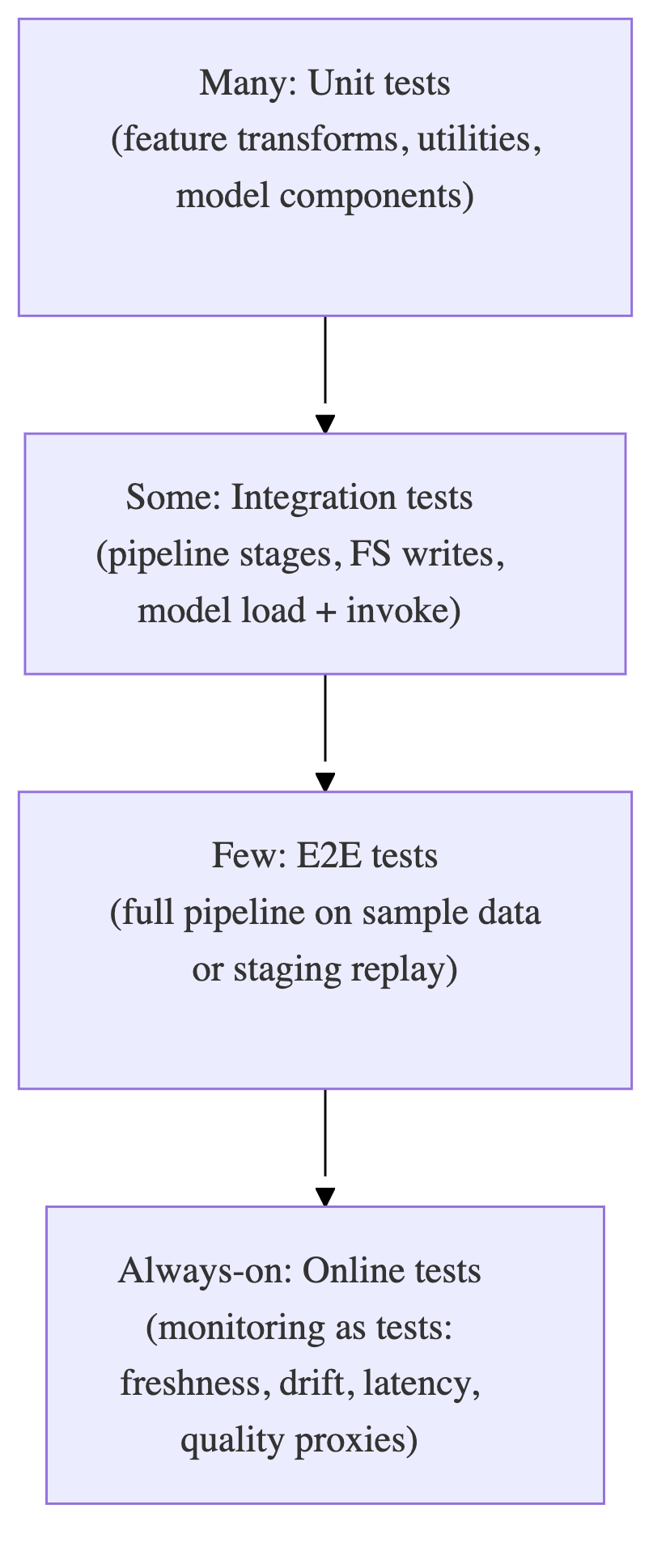
Rule: If an E2E test is flaky, replace it with 2–3 lower-level contract + integration tests.
3) What to test (the “quadrants”)
Think across Artifact × Stage.
| Artifact | Offline / Development | Online / Production (monitoring as tests) |
|---|---|---|
| Code & Pipelines | unit + integration + pipeline E2E + contract tests | pipeline health, dependency change monitoring |
| Data | schema, integrity, distribution checks, leakage, PII checks | data quality monitors, drift/skew, anomalies in streams |
| Model | pre-train sanity, behavioral tests, robustness, slices/fairness, calibration, regressions | quality (GT/proxies), skew, concept drift, numerical stability, latency |
| Infra | model spec tests, pipeline integration, canary/rollback tests | serving availability, load/latency, rollout monitoring |
4) Code & pipeline testing playbook (written logic)
A) Unit tests (fast, lots)
Test atomic logic:
- feature transforms (date parsing, bucketing, normalization)
- schema/contract utilities
- custom layers/losses
- encoding/decoding, post-processing
Heuristic: Refactor notebooks into functions first; otherwise you can’t test.
B) Integration tests (some)
Test interfaces between components:
- raw → processed → feature store write
- model package load + inference in a container
- training pipeline stages with mocks/stubs for external deps
Make integration tests robust
- assert coarse properties (schema, row counts, non-null rates), not exact row values
- mock unstable external services (DB/API) unless you’re explicitly testing them
C) Contract tests (critical in microservices)
If your feature service/model service consumes upstream APIs:
- validate request/response shape, status codes, types
- consumer-driven contracts (Pact-like) are ideal when multiple teams deploy independently
5) Data testing playbook (the fuel)
Minimum viable “DQ gates” (run before training / before insert)
- schema/types match expected
- null-rate thresholds
- row-count bounds
- value ranges (min/max/date bounds)
- uniqueness / dedupe keys
- set membership / regex patterns (categoricals/IDs)
- leakage checks (train/test overlap, time-travel)
Heuristic: Convert EDA findings into DQ tests—otherwise they vanish.
Drift vs skew (don’t conflate)
- Drift: live data distribution changes over time
- Skew: train vs serve mismatch (schema/feature/distribution differences)
Heuristic: Alert first on freshness + null spikes + schema breaks (highest signal, fastest to act).
6) Model testing playbook (learned logic)
A) Pre-train sanity checks (cheap, catches big bugs)
- output shape matches labels/task
- probabilities valid (sum-to-1, in [0,1]) where applicable
- loss decreases after a single gradient step on a batch
- can overfit a tiny dataset / one batch
Rule: If you can’t overfit a tiny batch, stop: pipeline/model is broken.
B) Post-train behavioral tests (beyond accuracy)
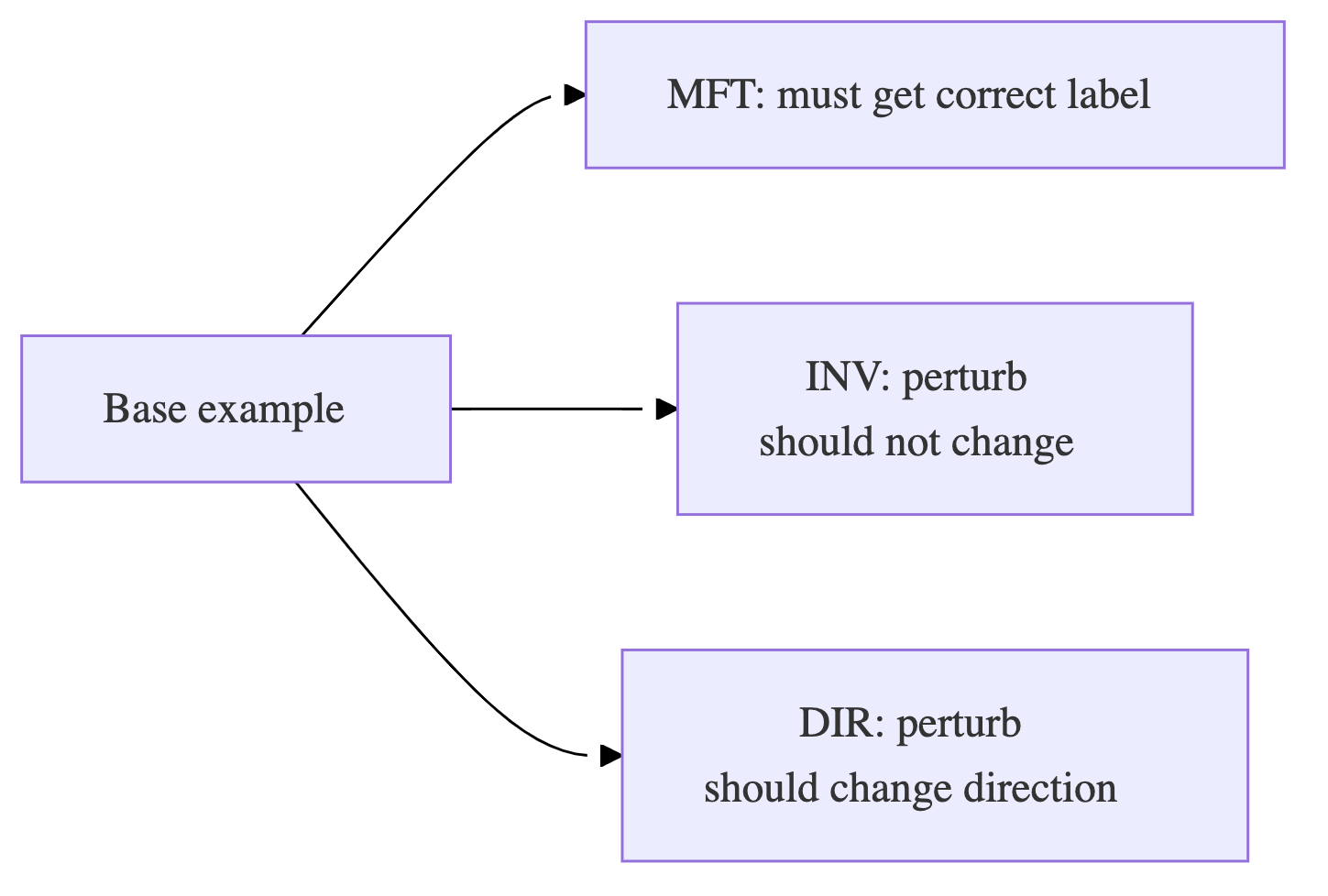
Use three kinds of tests (especially for NLP, but applies broadly):
- MFT (Minimum Functionality Tests): simple known cases must pass
- INV (Invariance): perturbations that shouldn’t change prediction (typos, synonyms, minor brightness change)
- DIR (Directional expectation): perturbations that should move prediction in a direction (add “not”, increase price, etc.)
C) Sliced evaluation (mandatory)
Always report metrics on critical segments (geo/device/user cohorts/rare classes).
Heuristic: If overall metric improves but a key slice regresses, treat it as a failed release unless explicitly accepted.
D) Calibration tests (if thresholds/probabilities drive actions)
- check reliability / calibration error
- calibrate on validation only (Platt/isotonic) and track stability
E) Model regression tests (your best long-term ROI)
Every production bug becomes:
- a stored failing example
- a test case that prevents recurrence
Rule: Incidents must generate tests. Otherwise you will repeat them.
7) Infra + deployment testing playbook
- model spec tests: artifact loads, signature/schema present, deps pinned
- canary tests in staging: model loads, endpoints respond, latency within bounds
- rollback tests: prove you can revert quickly and safely
Heuristic: A rollback plan that hasn’t been tested is not a rollback plan.
8) CI/CD wiring (how to run tests without blocking forever)
Fast gates (every PR)
- unit tests
- lightweight data tests (schema + basic expectations on sample)
- model sanity checks (shape, probabilities, overfit-batch on tiny data)
- build + import/packaging checks
Slower gates (merge to main / nightly)
- integration tests with real dependencies
- pipeline E2E on small representative dataset
- behavioral tests suite expansion (generated cases)
- load/perf smoke (latency + throughput baseline)
Release gates (promotion to prod)
- metric floors vs baseline/champion
- key slice floors
- latency/cost ceilings
- canary/shadow monitoring window
9) Handling nondeterminism (don’t write brittle tests)
Instead of asserting exact metrics, assert:
- ranges (AUC ≥ X, loss decreases, calibration within band)
- monotonic expectations (bigger input → higher score)
- statistical properties across runs (mean within band)
Heuristic: Your tests should fail on real regressions, not random seeds.
10) Prioritization (where to invest first)
Use Impact × Likelihood:
- P0: high-impact, high-likelihood → must test thoroughly (data schema/freshness, skew checks, rollback)
- P1: high-impact, medium-likelihood → comprehensive tests (slices, integration, contracts)
- P2: targeted scenario tests (robustness, specific edge cases)
- P3/P4: basic smoke/minimal optional
Rule: Spend most effort preventing the failures that can silently ship.
11) Debugging flow (when something breaks)
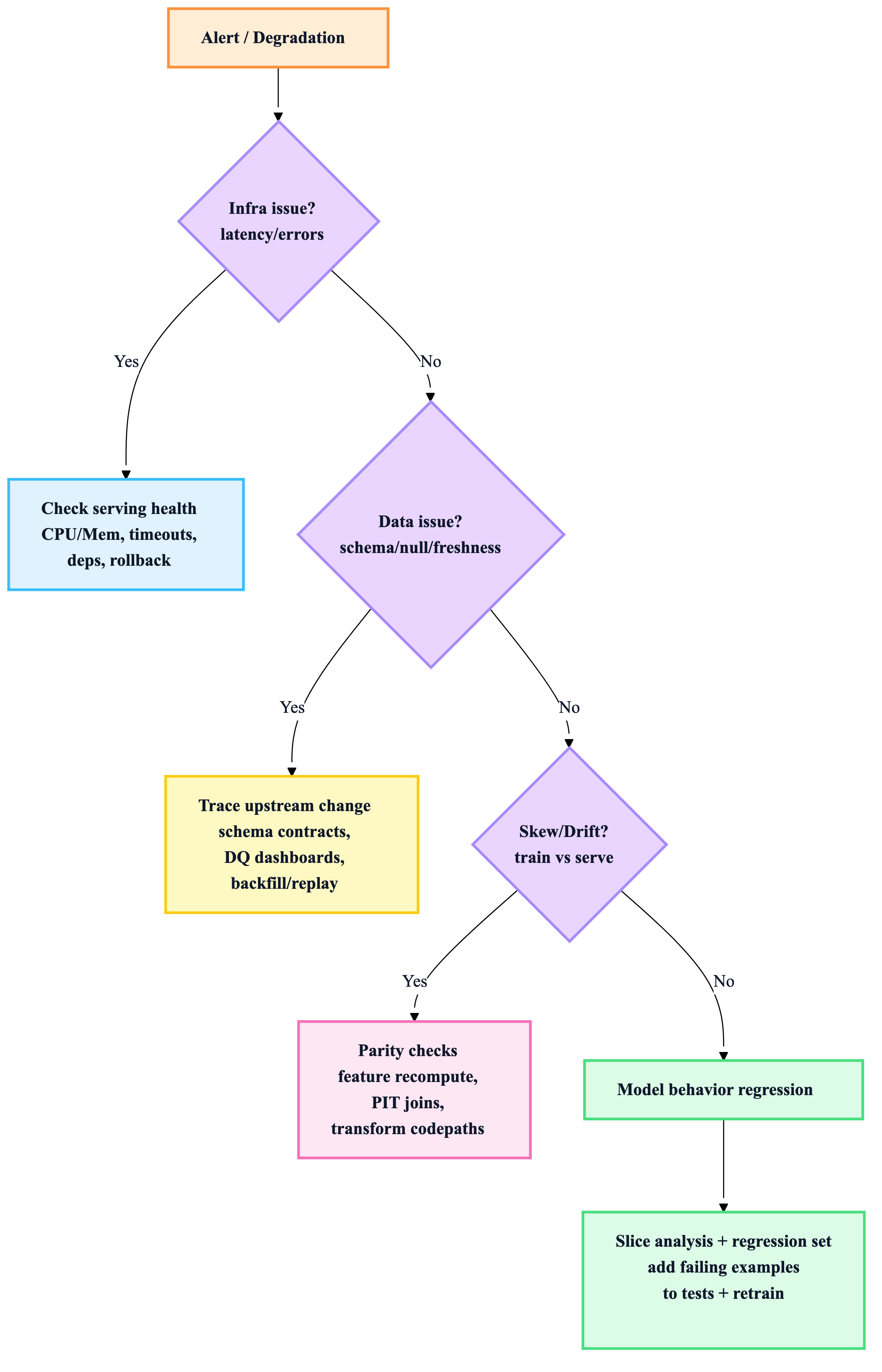
“If you only implement 8 things”
- Unit tests for feature transforms + utilities
- Integration test for “model loads + predicts” in container
- Schema + null-rate + range checks as gates
- Drift/skew monitoring in production
- Pre-train sanity checks (shape, prob bounds, overfit-batch)
- Slice metrics with hard floors for critical segments
- Regression set for production bugs (always grows)
- Canary + rollback tested, not just documented