Chapter 10.2: Inference Stack
Optimize inference with serialization, compilation, and runtime strategies
Inference Stack (Serialize → Optimize → Compile → Runtime → Server)
The core mental model
Inference performance and reliability come from layered responsibility:
- Serialization (portable artifact)
- Optimization (smaller/faster model representation)
- Compiler (hardware-specific plan/engine)
- Runtime (executes plan on hardware)
- Inference server (operational layer: APIs, batching, scaling, versioning, observability)
If you’re debugging latency/cost, first locate which layer owns the bottleneck.
1) What each layer does (don’t mix them up)
| Layer | Primary job | Typical output | “You know you need it when…” |
|---|---|---|---|
| Serialize | Make model portable + loadable | SavedModel / TorchScript / ONNX / safetensors | training and serving environments differ |
| Optimize | Reduce size/latency/power | quantized/pruned/distilled model | SLA/cost/edge constraints exist |
| Compile | Turn model graph into HW-tuned executable | TensorRT engine, OpenVINO IR, XLA compiled | GPUs/TPUs and tight p99/QPS matter |
| Runtime | Load + execute compiled/optimized model | predictions | you need efficient kernel dispatch + memory mgmt |
| Inference server | Production service mgmt | HTTP/gRPC API + batching + metrics | multi-model, autoscaling, dynamic batching, governance |
Rule: A great compiler doesn’t replace an inference server; it replaces slow kernels.
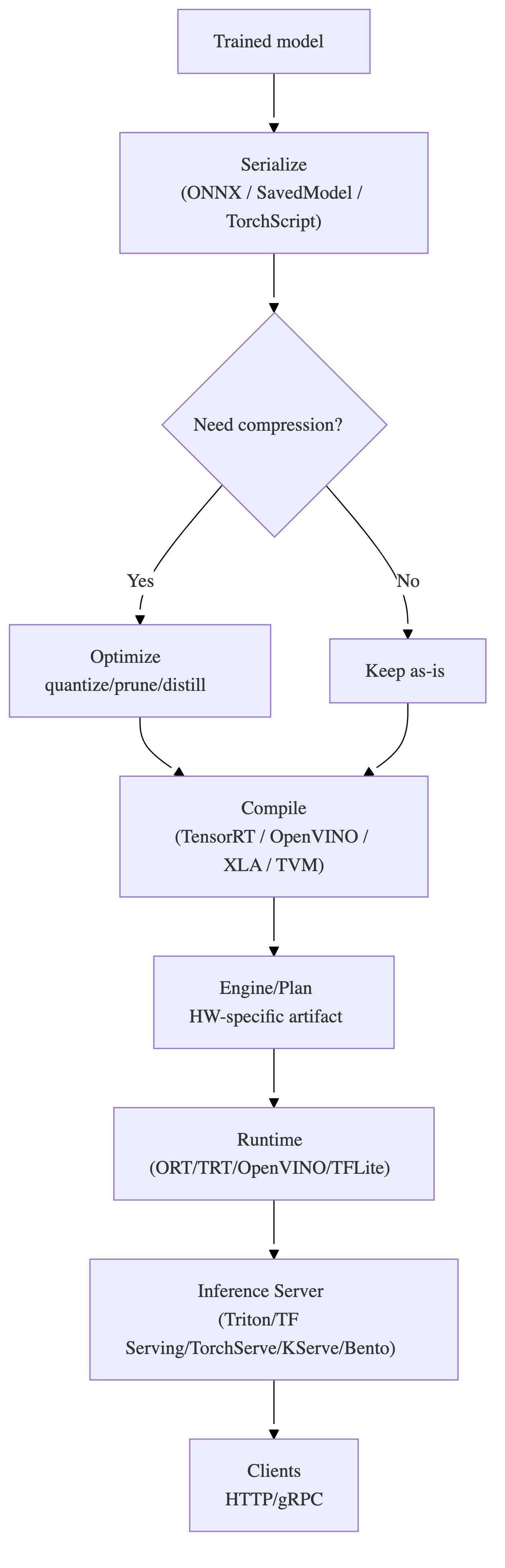
2) End-to-end flow (reference architecture)
3) Serialization choices (production-oriented rules)
Safe defaults
- Interoperability goal → ONNX
- TensorFlow ecosystem → SavedModel
- PyTorch deploy outside Python → TorchScript (script > trace when control-flow exists)
- Weights from untrusted sources → safetensors (avoid pickle risks)
Heuristic: choose serialization based on downstream toolchain compatibility (compiler/runtime/server), not just “what’s easiest to save”.
4) Compression: when and what to use (decision heuristics)
Quantization (most common)
- PTQ (post-training): fastest to adopt; requires calibration data for static INT8
- QAT: use when PTQ accuracy drop is unacceptable or you need aggressive low-bit
Rule of thumb
- latency/cost pressure + tolerant accuracy → PTQ
- strict accuracy + need INT8/INT4 → QAT or distillation-assisted quant
Pruning
- Structured pruning is more likely to yield real speedups on commodity runtimes.
- Unstructured often needs specialized sparse kernels/hardware to see latency gains.
Distillation
- best when you can train a smaller student to preserve teacher quality while cutting latency/cost.
Heuristic: start with quantization, then consider distillation, then pruning if the runtime/hardware can exploit it.
5) Compilers: what they really do (and why it matters)
Compilers perform graph + HW optimizations:
- operator fusion (reduce kernel launches + memory traffic)
- constant folding / dead-code elimination
- layout transformations
- kernel/tactic selection (often empirical, per GPU type)
Practical implications
-
compiler outputs are often hardware + version specific
- e.g., TRT engine built for one GPU arch may not be portable to another
-
compilation becomes part of CI/CD (or build pipeline), not “a one-time trick”
Heuristic: if you care about p99 latency at scale on GPUs, compilation is usually worth it.
6) Runtime engines: what to watch
Runtimes own:
- model/engine loading
- device memory planning
- kernel dispatch
- H2D/D2H copies (often a hidden cost)
- async execution primitives
Runtime selection heuristic
- ONNX Runtime is a strong “default runtime” because it can use multiple execution providers (CPU/CUDA/TensorRT/OpenVINO) under one API.
- Use TensorRT Runtime directly when you want max NVIDIA GPU performance and have stable shapes/tooling.
Rule: profile runtime-level overhead (copies, allocations, sync points) before blaming “the model”.
7) Inference servers: when you outgrow “FastAPI + model()”
You need a dedicated inference server when you need:
- dynamic batching and request coalescing (GPU utilization)
- multi-model hosting + versioning
- model lifecycle mgmt (hot reload, staged rollouts)
- standardized metrics + health checks
- high QPS with predictable p99
Server choice cheat sheet
- Triton: best-in-class for NVIDIA GPUs, multi-backend, batching, ensembles
- TF Serving / TorchServe: framework-native and solid defaults
- KServe/Seldon: Kubernetes-native platform features (canary, scale-to-zero, graphs)
- BentoML: developer-friendly packaging + flexible deploy paths
Heuristic: if GPU utilization is low and latency is high under load, you likely need better batching and concurrency—often via Triton/KServe.
8) The debugging playbook (find the bottleneck fast)
Step 1: classify symptom
- High p99 latency under load → queueing/batching/concurrency issues (server) or memory copies (runtime)
- Low throughput on GPU → batch sizing, dynamic batching, kernel inefficiency (compiler/runtime)
- Latency spikes → cold starts, model load, GC pauses, autoscaling churn (server/infra)
- Accuracy drop after optimization → quantization calibration/QAT issues (optimization)
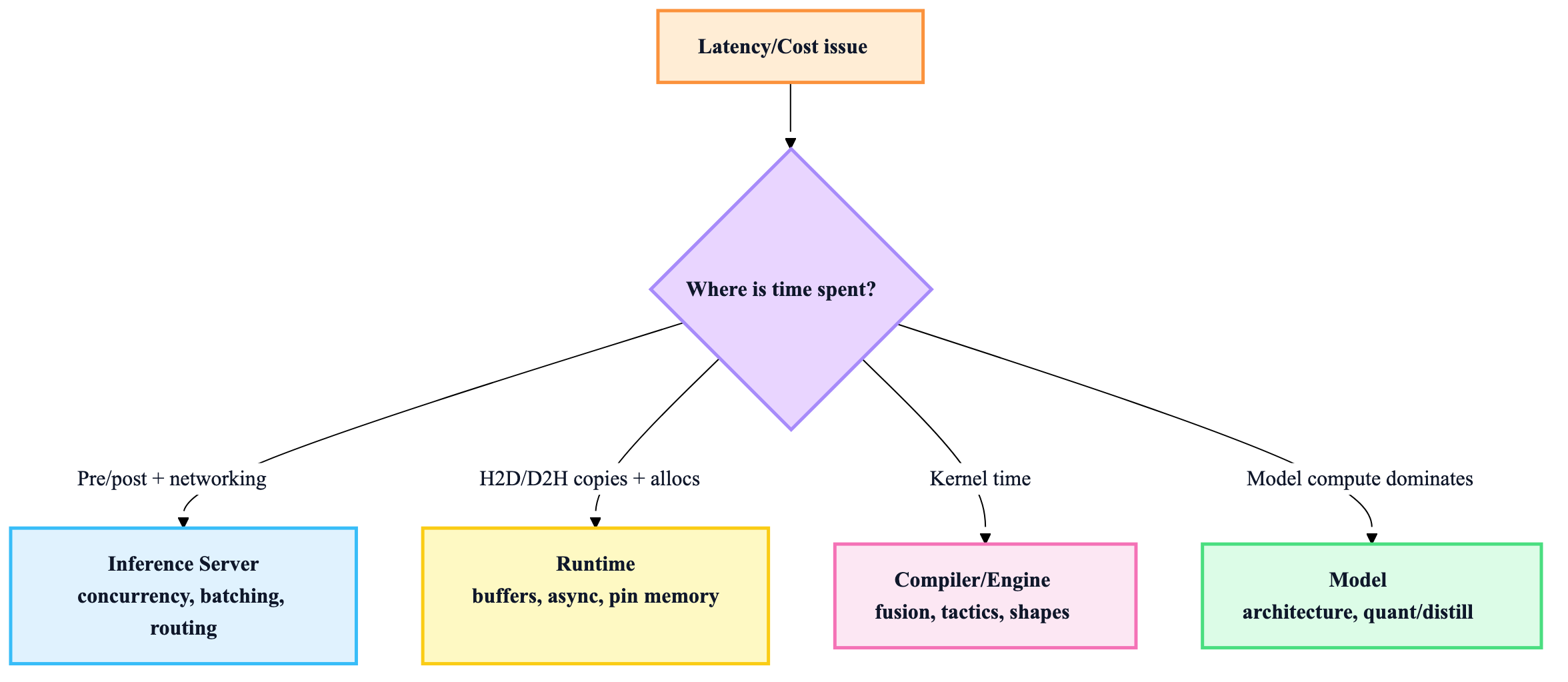
Step 2: locate the layer
Step 3: typical fixes by layer
- Server: enable dynamic batching, increase model instances, tune queue delay, switch REST→gRPC, add backpressure
- Runtime: reuse buffers, avoid per-request allocations, pin memory, async pipelines, reduce sync points
- Compiler: rebuild with correct shapes/profiles, enable FP16/INT8, adjust tactic sources, re-export ONNX cleanly
- Model: quantize/distill, reduce input size, multi-stage cascades
9) Design patterns that win in production
A) Multi-stage inference (cheap → expensive)
Use when candidate set is large or p99 is strict.

B) Hybrid execution providers (ORT)
Start with ORT CPU → switch to CUDA EP → optionally TensorRT EP for best perf.
C) Build once, promote artifacts
- build serialized + compiled artifacts in CI
- validate in staging on target hardware
- promote identical artifacts to prod
Rule: don’t rebuild engines between staging and prod.
10) Inference stack readiness checklist (copy/paste)
- serialization format chosen based on downstream toolchain
- optimization objectives defined (latency/cost/size) + acceptable accuracy loss
- compile step reproducible and tied to target hardware/versions
- runtime profiled (copies, allocations, syncs)
- inference server supports batching/concurrency/versioning/metrics
- rollout plan (shadow/canary) + rollback validated
- monitoring: p50/p95/p99, QPS, errors, GPU util, queue delay, prediction drift