Build My Home Copilot
An Agentic Home-Building Operating System for Transparency, Planning, and Trust
Positioning “A supervised agentic platform that helps homeowners plan, budget, design, and execute home construction projects with full transparency — coordinating architects, engineers, contractors, and vendors while keeping humans in control.”
1) Executive snapshot
ICP
- Aspiring home builders
- Homeowners undertaking self-builds or major renovations
- Premium architects / design–build firms (as a client-facing platform)
Primary Job-to-be-Done
“Plan and build my home on time and within budget, without getting blindsided by hidden costs, delays, or opaque decisions.”
Wedge workflow End-to-end Home Build Planning Pack:
- scope definition
- budget & timeline estimation
- design coordination
- vendor comparison
- execution plan with checkpoints
Why an agentic system (vs spreadsheets, WhatsApp, or portals)
- Home building is long-horizon, constraint-heavy, and sequential
- Decisions compound (early design mistakes → costly rework later)
- Requires planning, critique, simulation, coordination, and approvals
Autonomy level Supervised Autopilot
- Agents propose plans, estimates, schedules, and vendor options
- Humans approve designs, budgets, contracts, and payments
North-star KPIs
- budget deviation (% overrun)
- timeline deviation (weeks delayed)
- rework incidents
- homeowner trust score (approval without edits)
2) Product experience & UX
Core UX paradigm
“A transparent control tower for your home build.”
Primary surfaces
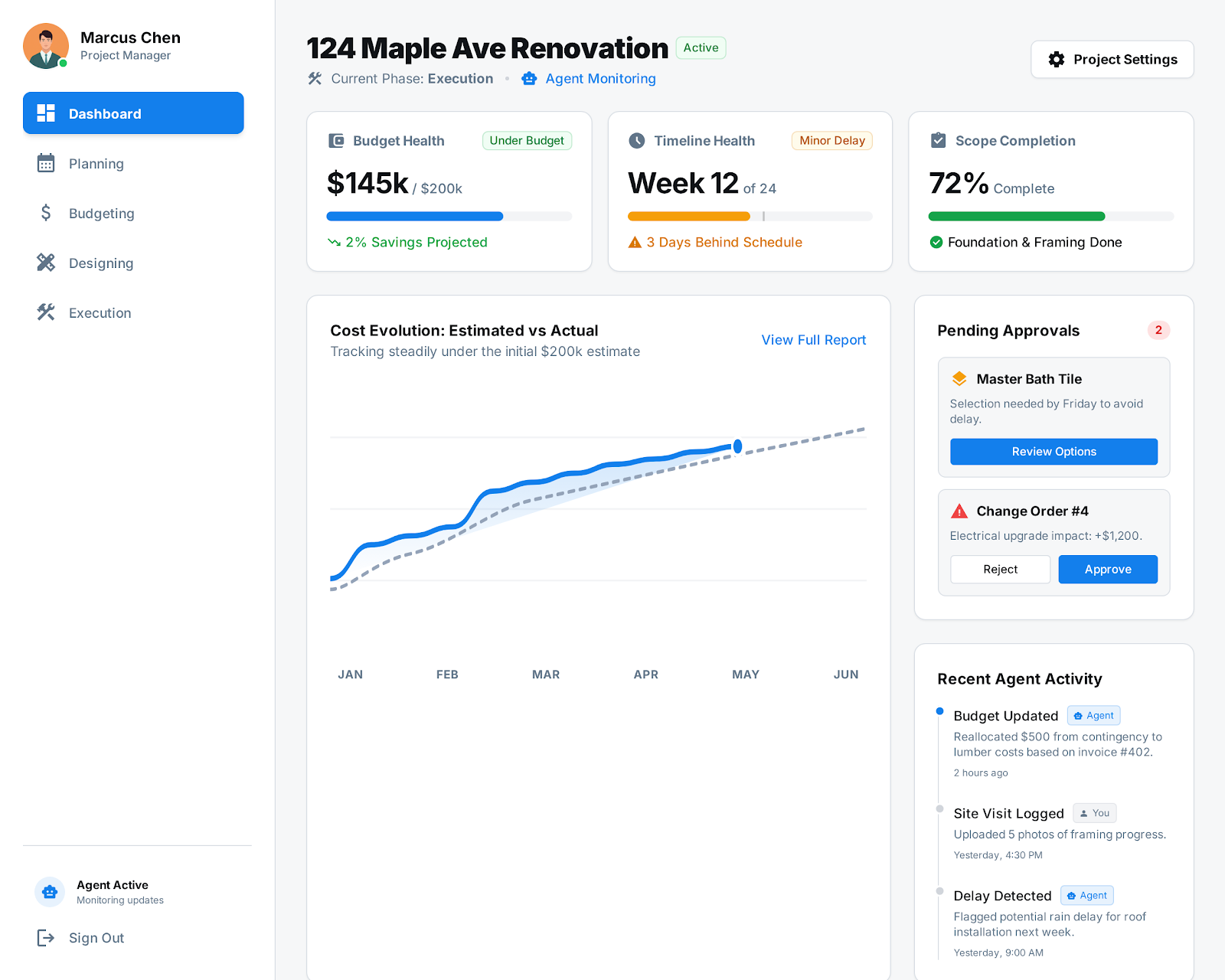
- Project Dashboard (scope, budget, timeline health)
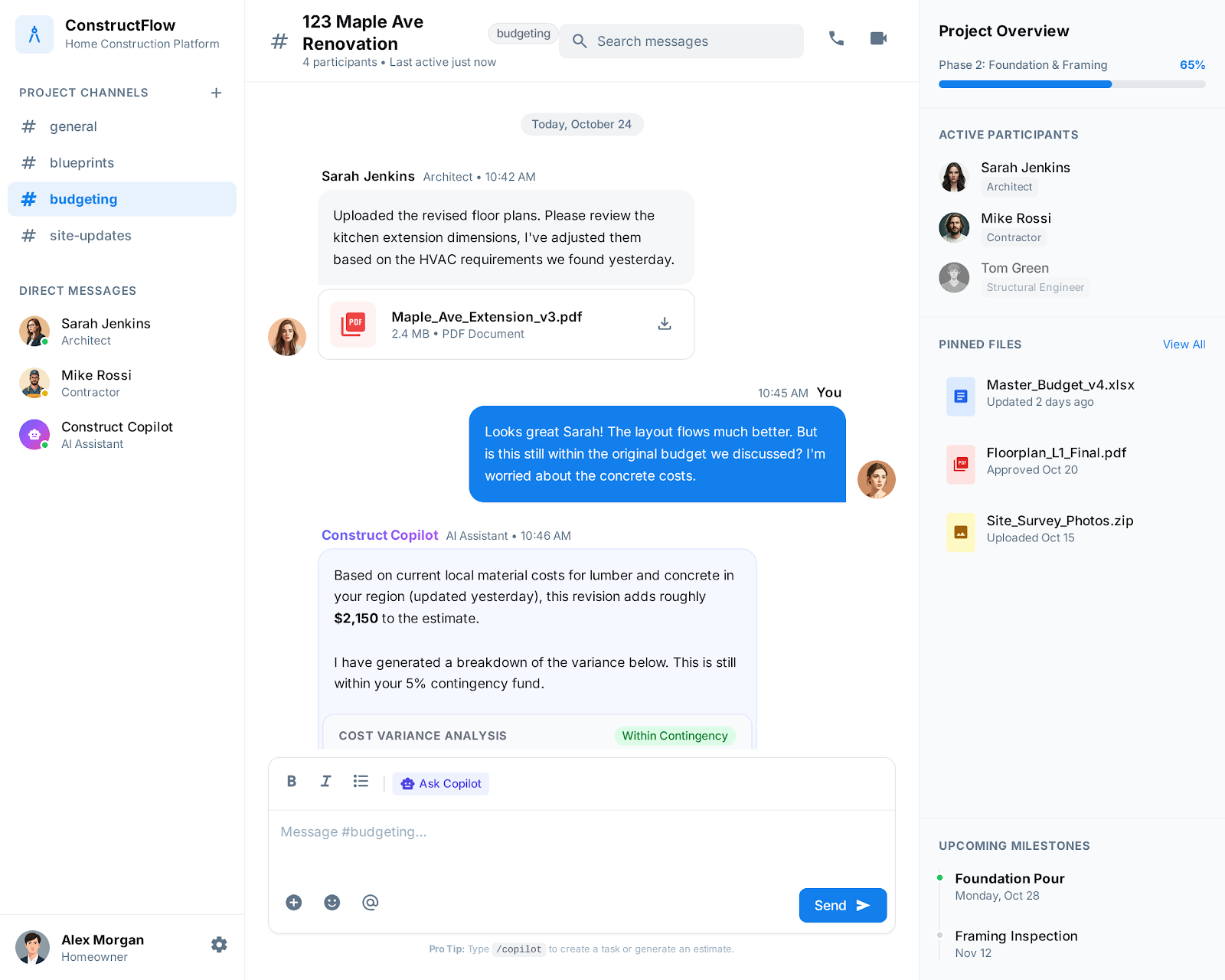
- Collaborative Group Chat (Homeowner + Architect + Engineer + Contractor + Copilot)
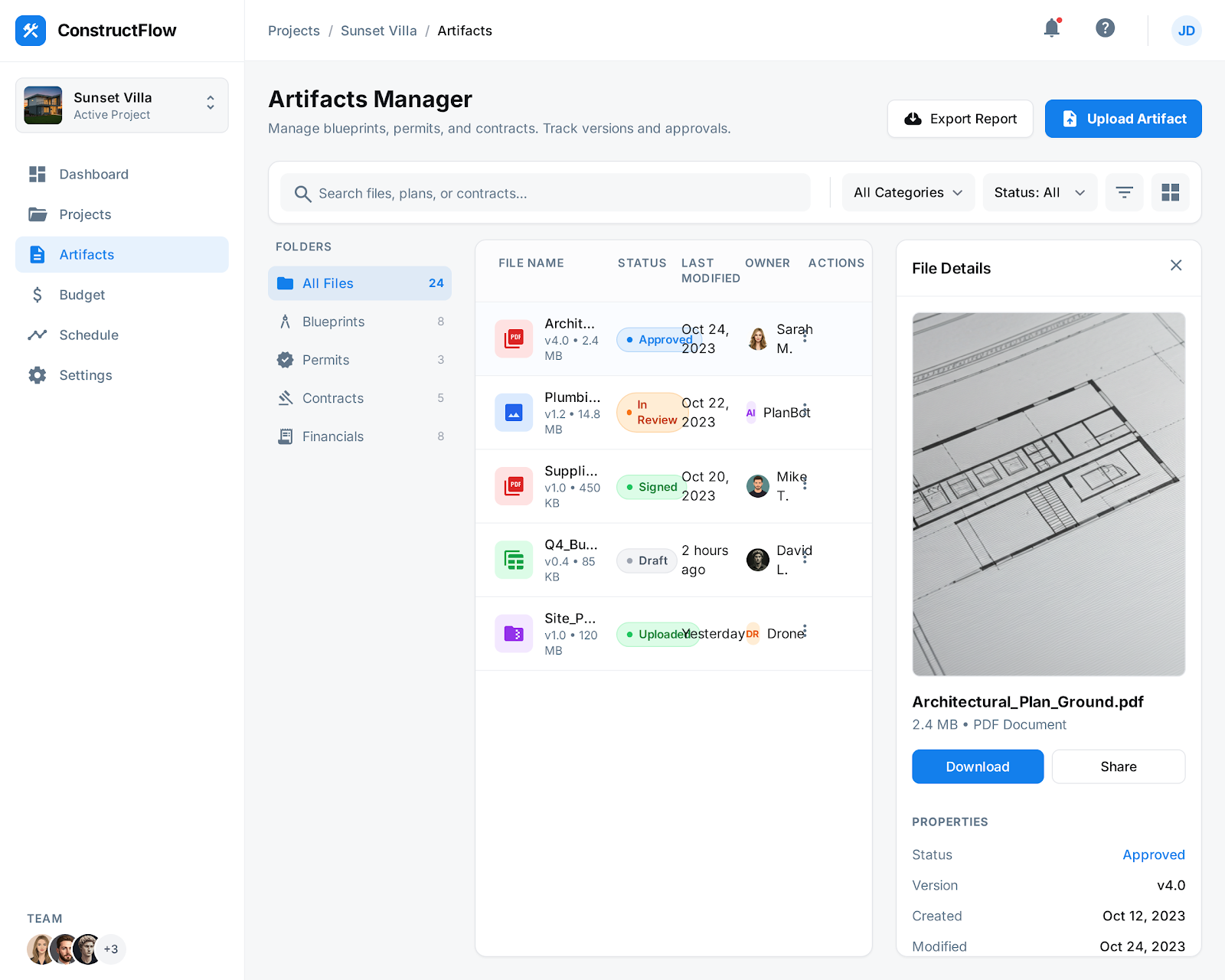
- Artifacts Panel (plans, BoQs, estimates, contracts, permits)
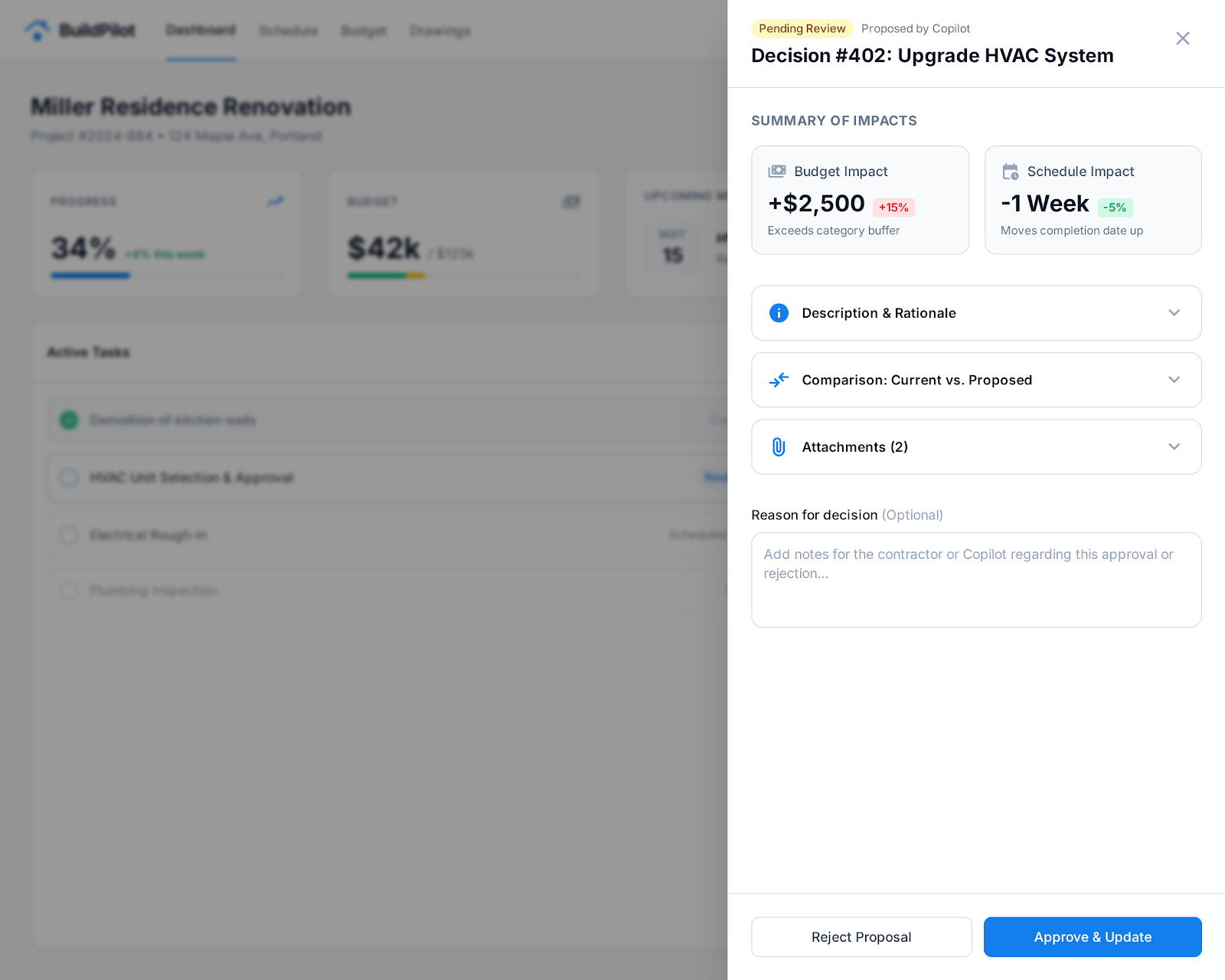
- Decision Review Drawer (approve/reject with rationale)
- Change Impact Viewer (“If you change X, cost/time changes by Y”)
UX principles
- Radical transparency (no black-box estimates)
- Change impact before commitment
- Every decision is explainable and reversible (where possible)
- Human approval for all irreversible actions
3) Agent design map
Skills (domain expertise)
- Architect (layout, design tradeoffs)
- Structural Engineer (safety, feasibility)
- MEP Engineer (electrical, plumbing, HVAC)
- Cost Estimator / Quantity Surveyor
- Project Planner (schedule, dependencies)
- Procurement Specialist (vendors, materials)
- Legal/Compliance Reviewer (permits, contracts)
Subagents (executors)
- Requirements Interpreter (family size, lifestyle, constraints)
- Design Validator (checks design vs regulations)
- Cost Estimation Agent (BoQ, regional price benchmarks)
- Timeline Planner (critical path, dependencies)
- Vendor Comparison Agent (quotes, reviews, risks)
- Change Impact Analyzer (delta cost/time/risk)
- Document Generator (contracts, milestone plans)
Planner / Orchestrator
-
milestone-based state machine:
- scope → 2. design → 3. estimate → 4. vendor selection → 5. execution → 6. handover
-
interruptible with HITL at every milestone
-
checkpointed for replay and audit
4) Tool & data plane (MCP-centric)
MCP integrations
- Local building codes & zoning rules
- Material price databases (region-specific)
- Vendor / contractor directories
- CAD / plan viewers (read-only)
- Document & contract repositories
- Scheduling & payment milestone tools
Tool design philosophy
- read-only by default
- dry-run previews for estimates and schedules
- explicit approvals for contract generation and payments
5) Context engineering plan
Pinned context
- homeowner requirements & constraints
- approved designs and drawings
- regional regulations
- agreed budget ceiling and timeline
Just-in-time retrieval
- material prices
- vendor quotes
- permit requirements per phase
Compaction
- long discussions summarized into “Decision Logs”
- superseded plans archived but referenced by version
Isolation
- cost agent sees prices, not personal family data
- legal agent sees contracts, not private notes
6) Evals & observability
Offline evals
- cost estimation accuracy vs historical builds
- schedule realism (critical path sanity)
- regulation compliance checks
- vendor recommendation quality
Online metrics
- approval-without-edit rate
- number of late-stage changes
- cost delta after approvals
- agent recommendation acceptance rate
Tracing
- every estimate → sources → assumptions → versions
- every change → impact analysis → approval record
7) Failure modes & mitigations
| What breaks | Detect | Constrain | Prevent regression |
|---|---|---|---|
| Unrealistic cost estimates | benchmark deviation alerts | approval gates | replay past overruns |
| Hidden dependencies | schedule conflict checks | block execution | dependency regression tests |
| Vendor bias or hallucination | source citation + reviews | limit to verified vendors | adversarial evals |
| Scope creep | change frequency metrics | change impact preview | enforce milestone locks |
| Trust erosion | edit/reject signals | slow down autonomy | retrain planning policy |
8) Governance posture & rollout
-
Permissions: agents cannot sign contracts or trigger payments
-
Approvals: homeowner + professional sign-off for milestones
-
Audit trail: immutable logs of estimates, changes, approvals
-
Rollout:
- design-only mode → estimation mode → execution planning
-
Kill switches:
- stop vendor recommendations
- stop schedule recalculation
This mirrors real construction governance, not consumer “AI magic”.
9) Business case & distribution
ROI
- fewer cost overruns
- reduced rework
- faster project completion
- higher homeowner confidence and satisfaction
Pricing
- per project (home build)
- premium tier for vendor coordination + execution planning
- enterprise tier for architecture/design–build firms
Distribution loops
- homeowners invite architects/contractors (collaboration loop)
- completed project templates reused (data loop)
- referrals from satisfied homeowners (trust loop)
Why Agentic RL is a strong fit here
Home construction is:
- long-horizon (months to years)
- multi-stage
- outcome-verifiable (final cost, delay, satisfaction)
- expert-reviewed (approvals at each milestone)
This makes it ideal for Agentic RL / RFT, as described in the agentic RL survey and OpenAI RFT guidance.
What Agentic RL optimizes
Instead of just “better explanations,” RL optimizes project-planning behavior:
- better sequencing of decisions
- earlier detection of downstream risks
- more conservative estimates where historically needed
- fewer late-stage design changes
- smarter escalation to human experts
Agentic RL training loop (home domain)
Trajectories
- requirements → design → estimate → vendor selection → execution plan → outcome
Graders
- cost accuracy vs final outcome
- schedule accuracy
- number of reworks
- homeowner approval signals
- safety/compliance adherence
Anti-gaming
- multi-grader reward stack
- holdout projects
- delayed rewards (final build outcome)
Expected business lift from Agentic RL
| Metric | Baseline | With RL |
|---|---|---|
| Cost overrun | High variance | ↓ 20–40% |
| Late-stage changes | Frequent | ↓ 30–50% |
| Timeline slippage | Common | ↓ materially |
| Homeowner trust | Moderate | High |
| Repeat/referrals | Low | High |
Key insight
Agentic RL turns the copilot into a learning construction manager that improves with every completed project.